
Jennifer Peedom’s Tenzing isn’t about conquering Everest. It’s about belonging to it.
There is a version of Tenzing that could have been a perfectly good mountaineering movie.
The true story certainly has everything one could ask for: impossible terrain, oxygen deprivation, political pressure, national pride and the knowledge that one wrong step at 28,000 feet can kill you. Director Jennifer Peedom gives us all of that — often with cinematography so staggering that the scale of the Himalayas almost becomes oppressive.
But Tenzing is doing something much more interesting.
It takes one of the most famous achievements in mountaineering history and asks us to look at it through the eyes of the man whose relationship with that mountain began long before the British decided it needed to be conquered.
Genden Phuntsok stars as Tenzing Norgay, the Himalayan mountaineer who, alongside New Zealand’s Edmund Hillary (Tom Hiddleston), became the first person confirmed to have reached the summit of Mount Everest in 1953. Willem Dafoe plays Colonel John Hunt, leader of the British expedition, with Caitríona Balfe appearing as expedition secretary Jill Henderson.
And while those names may sell the movie, Phuntsok owns it.
His performance is extraordinary.
Tenzing does not give him the luxury of one emotion at a time. Pride exists beside humiliation. Grief beside ambition. Faith beside doubt. He can desperately want the summit while simultaneously rejecting the very idea that the mountain exists to be conquered.
That distinction becomes the film’s beating heart.
For the British expedition, Everest is an objective. Hunt talks about the climb in the language of warfare: an assault, a siege, something Britain must accomplish before another nation does. The climbers are soldiers. The mountain is the opponent.
For Tenzing, she is Chomolungma — the sacred mother goddess.
At one point, the film puts the difference beautifully: the British see mountains as something to conquer. Tenzing sees them as part of himself.
The mountains are the bones. They are the blood.
That philosophy changes everything about the familiar Everest story.
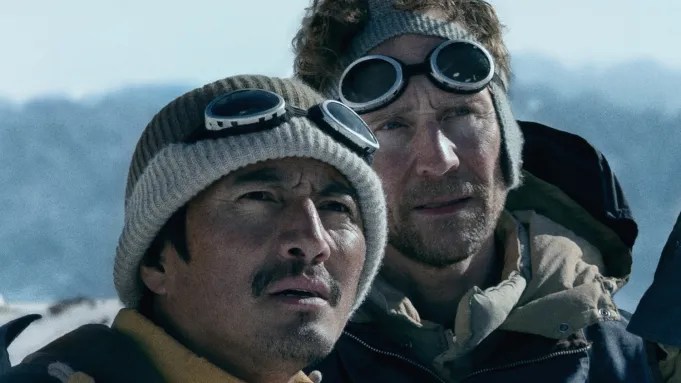
Who Gets to Stand on Top of the World?
Tenzing is also quietly furious about who gets to be considered an explorer and who is expected simply to carry the explorer’s equipment.
Tenzing has already climbed higher than almost anyone alive when the 1953 expedition begins. He knows the mountain. He knows the routes. He knows what went wrong during previous attempts.
And still, when the expedition needs his expertise, he’s a climber. When it needs someone to manage loads or Sherpas, he’s suddenly the “head Sherpa” again.
The film doesn’t need a speech explaining the indignity of that contradiction. It lets Tenzing live inside it.
Then there’s Hillary.
Hiddleston plays the New Zealander with a wonderfully understated warmth, and the film gradually positions him beside Tenzing as another outsider — obviously not subjected to the same cultural hierarchy, but nevertheless not quite part of the British establishment deciding whose names should make history.
When the initial summit attempt is assigned elsewhere, the message is difficult to miss.
Merit supposedly determines who gets the opportunity.
Until merit becomes inconvenient.
And ultimately, history belongs to the two outsiders anyway.
That makes the eventual partnership between Hillary and Tenzing enormously satisfying, but Peedom wisely resists turning their relationship into some overwrought inspirational friendship. Their trust develops practically. On a mountain where another person’s judgment can determine whether you live or die, respect means something.

The Love Story Hidden Inside Tenzing
Yet somehow, the part of Tenzing that affected me most wasn’t the summit.
It was Dawa.
The film moves between Tenzing’s expeditions and the life that brought him there, gradually revealing his relationship with his wife, played by Thinley Lhamo. What initially feels like background becomes essential to understanding the man climbing the mountain.
Tenzing has almost nothing when he asks Dawa to build a life with him.
What he can promise her are three things:
His hope. His future. His heart.
Frankly, there are entire romance movies that don’t manage to communicate as much about love as Tenzing does in that one relationship.
Because Dawa isn’t simply “the wife at home” waiting for the great man to accomplish the great thing.
She becomes inseparable from why the accomplishment matters.
By 1953, Tenzing is carrying grief up the mountain with him. His daughters are carrying it too. When one gives him something to take to the summit for their mother, the movie quietly transforms the destination.
The summit is no longer merely the highest point on Earth.
It’s somewhere he can bring her.
And when exhaustion and hypoxia begin stripping everything else away from Tenzing near the end of the climb, the movie’s spiritual, romantic and mountaineering stories finally become the same story.
That’s where Phuntsok absolutely wrecked me.
Peedom Understands Mountains
It makes perfect sense that Jennifer Peedom directed this.
Peedom previously made the acclaimed documentary Sherpa, and her familiarity with this world is evident in practically every frame. Tenzing doesn’t treat the Himalayas like an expensive backdrop for movie stars. The environment has weight, danger and spirituality of its own.
Cinematographer Stefan Duscio captures both sides of that relationship beautifully.
There are images here that are simply enormous — tiny human figures swallowed by white, ice formations that look almost alien, stretches of mountain that make ambition seem absurd.
But the filmmaking never loses sight of the people inside that scale.
The sound matters, too. Breathing matters. Footsteps matter. Silence matters. By the time these men are approaching the summit, every movement feels expensive.
Hiddleston is excellent as Hillary, finding humor and humanity without turning him into the protagonist of someone else’s story. Dafoe is exactly as good as one expects Willem Dafoe to be, particularly when Hunt’s genuine respect for Tenzing collides with the hierarchy and nationalism embedded in the expedition.
But this is Phuntsok’s film.
And he gives one of the performances I expect to still be thinking about at the end of the year.
The Summit Isn’t the Point
We know how Tenzing ends.
That should be a problem.
It isn’t.
On May 29, 1953, Edmund Hillary and Tenzing Norgay reached the summit of Everest. That fact has been repeated for more than seventy years.
Tenzing is interested in everything hidden inside that sentence.
Who carried the loads.
Who was allowed into the room.
Who was expected to sleep elsewhere.
Who was considered a worker.
Who was considered a climber.
Who got to decide what “merit” meant.
Who looked at Everest and saw territory waiting to be conquered — and who looked at Chomolungma and saw something closer to a mother.
By the time Tenzing finally stands at the top of the world, Peedom has made the achievement feel simultaneously enormous and deeply intimate.
He hasn’t defeated the mountain.
He hasn’t conquered her.
He’s come home.
Verdict
Tenzing is breathtaking filmmaking, but its greatest achievement has little to do with its scale. Jennifer Peedom takes an accomplishment most of us already know and returns the humanity to it, anchored by a remarkable performance from Genden Phuntsok and a love story far more affecting than I expected to find at 29,000 feet.
Come for the mountain.
Stay for the man history too often placed beside it instead of at the center of his own story.
10/10. No notes.
Tenzing opens in select theaters October 9 before streaming globally on Apple TV October 16.


Join the conversation
Be kind. Be curious. No fandom wars — we're all here because we love this stuff.